Articles
What Falling Enforcement Numbers Don’t Tell You
Bank enforcement is falling across every US regulator. The natural reading is that supervision has gone soft.
A new Brookings dataset (2015–2025) shows enforcement actions down sharply at the Fed, moderately at the FDIC, roughly flat at the OCC — regardless of which party held the White House. But a single falling number can't tell you why.
Run a simple exercise: fifty enforcement cases, five banks, ten types of misconduct, every case worth pursuing, resources for fifteen. Which fifteen?

Put this to a room of supervisors and four answers recur — take the most severe cases outright; spread across banks so none escapes scrutiny; spread across issue areas so no rule goes unenforced; or a hybrid of both. Each is coherent. None is the same theory. A regulator that drifts between them — or simply loses the resources to run any of them properly — produces a falling number indistinguishable from one that has stopped caring.
This isn't hypothetical. Fed enforcement by Vice Chair tenure: ~87/year under Tarullo, ~72 under Quarles, ~42 under Barr, ~37 under Bowman so far. Four philosophies, never once stated.
And the composition of what's being enforced — mostly AML/BSA, not capital or liquidity — matters for what's coming. 2025's removal of reputational risk from examination handbooks hasn't reached the numbers yet. Enforcement takes years to resolve. A further fall is likely, and specific enough to check.
US bank enforcement is falling across every regulator. A new dataset and an old thought experiment show why the number alone can’t tell you why.
Bank enforcement is down across every major US regulator since 2015. A new dataset, an old academic study, and a fifty-case thought experiment about welfare economics all help explain why the number alone tells you almost nothing about what’s actually happening inside supervision.
In July, Brookings published an analysis of US bank enforcement covering 2015 to 2025, and the numbers are stark. Formal enforcement actions have fallen at all three prudential regulators – the Federal Reserve, the OCC, and the FDIC – and the decline holds regardless of which party held the White House. The Federal Reserve’s fall is the sharpest: enforcement actions there are down by roughly 48 per cent since 2017–19, against 25 per cent at the FDIC and a broadly flat picture at the OCC. The natural reading, and the one the authors eventually settle on, is that supervision has become more lenient – that banks are being watched less closely, policed less firmly, let off more easily.
There are several problems with that reading, though they aren’t the ones you’d expect. It isn’t that the numbers are wrong. It’s that a single count of enforcement actions can be produced by supervisory regimes doing completely different things, for completely different reasons, and there is no way to tell from the outside which it is. They could, for example, be taking fewer but bigger cases. But the biggest problem is that we don't know why the cases have been picked.
Imagine fifty enforcement cases. Each is identified by which of five banks was involved and which of ten types of misconduct it concerns – misselling, say, or anti-money-laundering failures. Every case has been ranked by severity, from the most serious to the least, and every one of them is worth prosecuting. But you have the resources for fifteen.
Which fifteen do you choose?
Run this exercise with a room full of supervisors, and four answers consistently emerge. Some people take the fifteen most severe cases, full stop – the utilitarian answer, maximising the harm addressed per case pursued. Some spread the load evenly across the five banks, so that no institution escapes scrutiny – a Rawlsian instinct, protecting against the worst-off outcome, which here means the bank nobody’s watching. Others spread across the ten issue areas instead, on the theory that a rule nobody enforces stops being a rule. And some do a bit of both: a severity floor, then coverage with whatever capacity remains.
None of these is wrong. Each is a coherent, defensible theory of what enforcement is actually for – deterrence, equality before the law, regime legitimacy, institutional capability. What they are not is the same theory, and a regulator that quietly moves from one to another, or simply loses the resources to run any of them properly, will produce a falling number that looks identical to a regulator that has genuinely stopped caring. The count cannot distinguish philosophy from neglect.
This is not hypothetical. Brookings’ own data breaks enforcement down by the tenure of the official responsible for it. The Federal Reserve’s sequence is a philosophy experiment playing out in public, whether anyone intended it that way or not: an average of around 87 enforcement actions a year under Governor Tarullo, falling to about 72 under Quarles, 42 under Barr, and 37 so far under Bowman. Four different people, four different resource envelopes, and – as far as the public record shows – not one of them ever stated which philosophy they were running. We are left to infer it from a shrinking number, which is precisely the inference the number cannot support.
There’s a second reason for caution, and it’s one the Brookings paper’s own methodology anticipates better than its conclusion does. The authors note, early on, that a falling count is compatible with either less misconduct or less enforcement – and then largely set that caution aside by the end. It’s worth taking more seriously than they do, not less. A 2023 study by David Zaring, examining every civil monetary penalty the Federal Reserve issued between 1997 and 2022, found that the overwhelming majority concerned anti-money-laundering and Bank Secrecy Act compliance, not capital or liquidity shortfalls – the harder, more measurable end of prudential regulation. He also found that penalties against individuals, once common in the late 1990s, have become rare; institutions now absorb almost all of it.
That composition matters for what comes next. Over the course of 2025, US bank regulators began systematically narrowing what counts as a legitimate supervisory concern. The OCC removed references to reputational risk from its examination handbook in March. The Federal Reserve followed in June, shortly after Michelle Bowman was sworn in as Vice Chair for Supervision. In October, the three agencies jointly withdrew their climate risk management principles and proposed a rule barring examiners from criticising a bank on reputational grounds at all – a rule finalised the following April. The stated rationale, in the regulators’ own words, is to focus supervisory effort on data-driven and measurable risks rather than the softer, judgement-heavy findings that AML and compliance work has always required.
Enforcement cases typically take upward of two years to move from opening to resolution, which means almost none of this has had time to reach the numbers yet – the Brookings dataset ends before the reputational-risk rule even took legal effect. If Zaring is right about what Fed enforcement has actually consisted of, and if the new framework genuinely disfavours the judgement-heavy compliance findings AML work depends on, the honest prediction isn’t that the decline has bottomed out. It’s that a further fall is coming, on a two-to-three-year delay, and it’s specific enough to check.
None of this resolves which philosophy of enforcement is the correct answer, because there isn’t one – that’s the point of the exercise. But it should retire the idea that a single number, moving in one direction, tells its own story. It doesn’t. It never has. Regulators, whether or not they’ve read a page of Bentham or Rawls, are making these choices constantly, often implicitly and mostly in silence. The rest of us are left reading the silence and guessing.
The Economics of “What for?
"What is it for?" In his review of Robert Skidelsky's last book, "Keynes for Our Times", Lyndon Nelson takes up Keynes's warning that uncertainty cannot be dissolved into probability — that economics is a moral science, not physics — and why, in the age of AI, that is the question we most need to ask.
Lyndon Nelson, in his review of “Keynes for Our Times”, by Robert Skidelsky, points out that the book provides a timely reminder of the fact that, even with all the computing power and data conceivable, uncertainties remain and these cannot be captured in a risk curve – which is why economics is about moral choices and financial innovation is not always useful or desirable. This article first appeared in Financial World’s May 2026 Edition. It went free to view in June
Among the more arresting passages in Robert Skidelsky's last book is one in which Keynes is asked, by proxy, what he would have made of the current enthusiasm for artificial intelligence. The answer, channelled by his great biographer, is bracing. The dream that AI will at last "dissolve uncertainties into probabilities, probabilities into frequencies" is a category mistake. Perfect hindsight, Skidelsky writes, does not guarantee perfect foresight; the hubris of humans playing at being God ends, as ever, in nemesis.
Lord Skidelsky died on 15 April 2026. Keynes for Our Times — short, sharp, distilled from four lectures given in Pisa — is therefore both his latest reflection on the subject he made his life's work, and his last. That this is also unmistakably late work, written with the freedom of a man no longer needing to prove anything, gives it a quiet authority quite apart from the merits of its argument.
And there is an argument. This is not a primer; a reader without some Keynes already in them will find the chapters on monetary theory tough-going. It is, rather, a connected reflection on what the discipline lost when it decided to imitate physics, and on why a certain kind of statesman-economist, comfortable with uncertainty and unembarrassed by plain language, may be more useful in 2026 than at any time since the 1940s.
Risk and uncertainty
The argument begins where Keynes himself began: with philosophy. In his 1921 Treatise on Probability, which Skidelsky’s first chapter walks the reader through briskly, Keynes distinguished between numerical probabilities, non-numerical probabilities, and cases in which no rational ranking of probabilities is available at all. That distinction later became central to his economics of uncertainty. Investment is governed by ‘animal spirits’ precisely because the future of a long-lived asset is uncertain in this strong sense, not merely risky.
The lesson, Skidelsky argues, has been quietly mislaid. Modern finance, modern economics, and now modern artificial intelligence proceed on the assumption that with enough data, enough computing power, and enough cleverness in the choice of model, uncertainty can be reduced to risk and risk to a manageable distribution. Skidelsky's reply, phrased in Keynes's own terms, is that the assumption is false. AI's apostles, he writes, dream of computers that will reduce all uncertainty to ordinary statistics. The dream is appealing and entirely mistaken.
Anyone who has watched a model break in real conditions will recognise Skidelsky’s argument. The 2008 risk models did not fail merely because of a bug; they failed in part because they had been trained to treat uncertainty as risk. The same instinct shows up in many contractual triggers written into instruments designed to absorb losses in a crisis the model could not see coming, and in stress testing, whose purpose is not to assign neat probabilities but to ask what would happen if the standard apparatus proves unequal to the world.
Economics as a moral science
If the standard apparatus cannot reach everything that matters, what is left for economics to do? Skidelsky answers that the discipline was always meant to be something other than physics, and that pretending otherwise has cost it dearly. Keynes called economics a moral science: a discipline involving introspection, motives, expectations and values, and therefore one that could not avoid the distinction between what is desired and what is desirable — a distinction he thought Bentham and his utilitarian heirs had wantonly collapsed.
This is the philosophical hub from which the rest of the book turns. Skidelsky shows, with the patience of long acquaintance, that almost every distinctive Keynesian move, from the rejection of mathematical formalism, to the insistence that money matters in itself, to the famous remark that in the long run we are all dead, proceeds from the same conviction. Economics is for living well. Means and ends must not be confused.
The application to the present is not laboured, but it is unmistakable. Skidelsky observes, sharply, that the argument that because something is technically possible it should therefore be done, that because more advanced AI is achievable we must continue to pursue it, and, by extension, that because more financial innovation is possible we must permit it, is a textbook example of what Keynes would have called the naturalistic fallacy. He would have wanted to know, as the book repeatedly insists, what it was for.
This will read to some economists as a quaint complaint, the kind of thing regulators are paid to worry about. But the deeper point is that the question "what is it for?" is not soft; it is the only question that gives the technical apparatus its bearings. Without it, the cleverness of the means becomes its own end, a familiar pathology to anyone who has watched a market lose its sense of purpose.
Words as deeds
A whole chapter is given over to Keynes the persuader. Few economists today, Skidelsky writes, try to express their ideas in commonsense language. They prefer to demonstrate them in mathematics. Keynes, who could do the mathematics when it suited him, preferred prose because he believed economics was a kind of statesmanship, and because words for him were not descriptions but actions, devices for moving both thought and feeling.
The argument is not nostalgic. It bears directly on a problem that has occupied central banks for the last fifteen years: how to make policy effective when its transmission depends on belief. Forward guidance, "whatever it takes”, "lower for longer”, and the great pieces of central-bank communication of the modern era are all in this Keynesian register. They are arguments dressed as analysis, instruments rather than descriptions. That a central banker’s or regulator's words can move a bond market by twenty basis points is a daily reminder that economics is not the science it sometimes claims to be.
Skidelsky's chapter is not a defence of vague language. He is precise about Keynes's precision. The point is that the right register for a discipline is the register that does the work, and that mathematical formalism, however elegant, has often hidden rather than clarified what the argument actually is. There is a warning in this, gently delivered. The replacement of plain prose with technical apparatus has not always made economics more rigorous; it has often made it less able to argue with the public it serves. I suspect this is a warning that many central banks and regulators have been taking notice of, especially since the political shocks of 2016 and the inflation surprises of the early 2020s. The recent moves by the Bank of England in how it communicates uncertainty around its inflation forecast are very much in this spirit.
Paradise postponed
The book’s most surprising chapter is on Keynes’s 1930 essay “Economic Possibilities for Our Grandchildren”. The famous prediction was that by now, Keynes's grandchildren (us), would be working a fifteen-hour week, the economic problems essentially solved, and free at last to confront what he called the permanent problem of how to live wisely, agreeably and well.
The arithmetic was almost right. Income per head in rich countries has grown roughly fivefold in real terms since 1930, much in line with Keynes's expectation. But the working week has fallen by only about a third. We are five times wealthier, and we still work far more than Keynes expected. The additional wealth, Skidelsky observes, has gone into goods rather than into time, a choice shaped, he is at pains to add, by relentless advertising, by the concentration of productivity gains in too few hands, and by an idea of sufficiency that recedes as it is approached. Keynes's grandchildren, it seems, preferred the goods.
This is the book's quietest and most powerful note. Skidelsky asks, on Keynes's behalf, what economic growth is for in countries that have long since solved the problem of material want. It is a question that financial professionals are well placed to think about, having been close to the centre of the machine that has produced both the wealth and the dissatisfaction. The book offers no neat answer. Keynes did not have one either. The question is the point.
A late book
Keynes for Our Times is not the great Skidelsky biography in compressed form; it is something more interesting than that. It is a late, opinionated reading by a writer who knew his subject better than anyone, made all the more pointed by the freedom of being work done at the end of a long life. The contemporary chapter, on tariffs, trade imbalances and what Skidelsky calls military Keynesianism, is the book's most rushed; one suspects he meant to write more on it. He will not now, and that is the loss this review can only register. As a beacon, the book illuminates. As a warning, it is uncomfortably timely. Both are deserved.
Data Delusions: Why the Industry Should Worry About Deregulation
Deregulation is presented as pro-industry, in particular as saving costs. But the opposite can often be true, especially over time. Following on from the recent article Lyndon Nelson wrote on the deregulation bills in the King's Speech, the article below takes a closer look at the idea of cutting the data that regulators require firms to provide... The results are likely to be messy and expensive, for firms as well as regulators... The present system needs to change but there are better paths forward...

Following on from @Lyndon Nelson's recent article on the deregulatory bills in the King's Speech, their prioritisation of growth, and the unacknowledged trade-offs involved, I want to explore why industry should be extremely wary of such initiatives that, at first glance, appear to be a win. Much of what seems to be proposed, in fact, is likely to be far more costly for regulated firms, in both the short and long term, than is generally understood. There are better options.
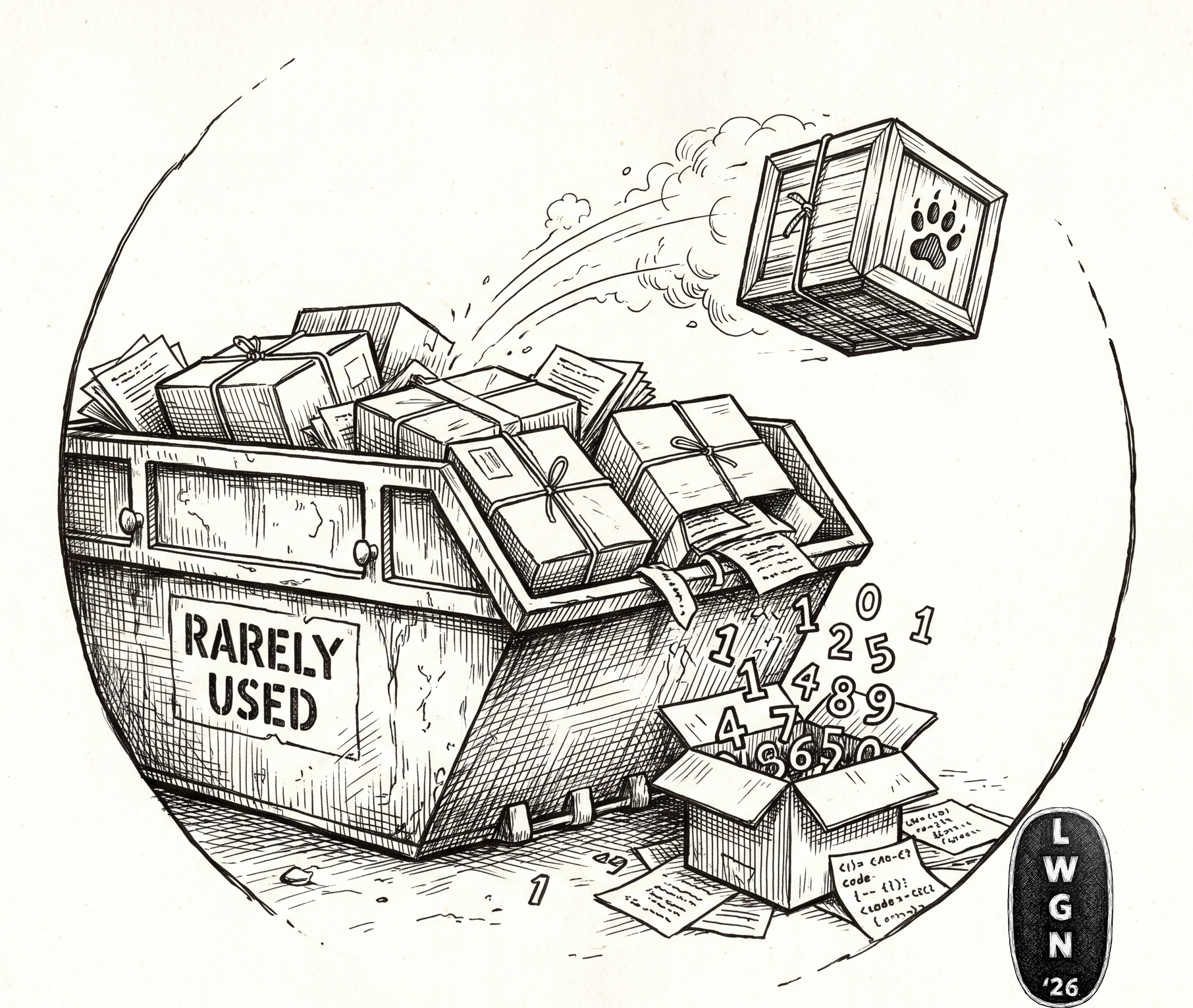
Let's focus on what is perhaps the most obvious target for those in the deregulation camp, the regular data that the regulator requires industry to provide. This has been a bugbear from time immemorial, and, as a villain, it has a lot to commend it. While new data requirements are regularly added, old ones are rarely, if ever, withdrawn, and much of what the regulator collects is rarely looked at, let alone analysed. Fixing this must be simple; just eliminate the data that the regulator uses the least.
But the equation is nowhere near as straightforward.
Most obviously, other regulators might still require some of that data - the EU, US, etc. – and, because it's cheaper to run a single reporting system than several, firms with an international footprint often gear their systems to the highest set of requirements. So, the UK decommissioning this data would look good on the UK regulator's scorecard, but it would save these firms nothing.
Regular and standardised data returns are unpopular in the industry because they entail a high upfront cost to build the requisite systems. Once built, however, these are cheap to operate. Less standardised reporting might save some of this initial spend, but it inevitably leads to more ad hoc requests, in which the regulator requires firms to provide one-off or temporary data sets to respond to a particular situation. Because firms are unlikely to have the systems needed to collect such data to the regulator'sspecifications, the exercise becomes more 'manual', and the cost of each individual request is high. These will quickly add up. A reporting world more dependent on ad hoc data will almost certainly be much more expensive for firms in the long run.
A regulator without the right data exposes society to serious consequences. Data can fail a regulator in two ways. A return that looks redundant in calm times may be cut, only to be sorely missed when a crisis arrives, or the capability may simply never be built in the first place.
Take liquidity. Before the financial crisis, the UK did not ignore it: large banks were subject to a stock-liquidity regime requiring high-quality assets against severe stressed outflows, calibrated well beyond anything previously experienced. The flaw was that this was only ever meant to be the first of several pillars. The others — foreign-currency liquidity, contingent liquidity, and what we would now call operational resilience — became bogged down in negotiation and were never completed. A regime designed to be comprehensive was left partial, and a widespread conviction that the world had changed removed any urgency to finish it. When the crisis came, the gap was exposed at great cost, and the regulator was rightly criticised. We can easily imagine how regulators would look if they had just discontinued a report that would shine a similar light on the next crisis.
In addition, the timeline for negotiating, formally consulting, and then implementing a new data report spans several years. All in all, there is no incentive for regulators to voluntarily relinquish information that took a long time to obtain. Everyone agrees that the present situation is far from ideal, and the cost to the industry is many billions, a good portion of which is unnecessary. So, are there better alternatives to cutting data returns and declaring success? Well, there are definitely better paths to travel…
One of them is to start looking at the system as a whole - the forest rather than the trees.
Today, almost nothing pushes either side to take that whole-system view. When the regulator seeks new information – on an activity that has grown quickly, say, or become more complex – the industry argues the number of items down to reduce its build cost: ask for ten, be offered eight. The regulator, under persistent pressure to control its own budget, often finds it easier to accept the smaller set and pick up the rest later through ad hoc requests. Each side has minimised the cost it can see; the system as a whole pays more.
Nor are ad hoc requests the cheap fallback they appear to be, even for the regulator, and not only in money. Asking for data signals concerns. After a shock – the closure of the Strait of Hormuz, say, or a sharp move in prices – a regulator that suddenly asks a firm for its specific exposures may find the firm reacting to the request itself, cutting lines or positions before anyone yet knows whether there is a real problem. Standing data carries no such signal; a system that relies on ad hoc collection cannot replace it without incurring costs.
Beneath all of this lies a question of visibility. The regulator's own budget is a single, scrutinised number – in the UK, it's long been expected to stay flat in real terms and, at times, in nominal terms – so it behaves quite rationally by minimising its own spending, even where a modest outlay would save industry many times that amount. The regulator can even require a firm to commission and pay directly for an independent 'skilled persons' report – a section 166 review – when the same work done by its own staff would fall on the general levy. Firms resist the direct charge far more fiercely than the levied one, though both ultimately land on the industry, and the latter is usually higher. It is the visibility of a cost, not its size, that too often drives the argument.
It is not that the cost to industry goes unmeasured. Every new requirement carries a cost-benefit assessment, weighing whether its benefits justify its cost. But that assessment is always incremental – each requirement judged on its own. What no process attempts to weigh is the standing cost of the whole regime. Each tree is inspected; the forest is no one's responsibility.
Looking at the whole cost base would involve recognising the data system as a shared public good, much as we treat payment systems. The result would be a partnership model between industry and regulators, with Government oversight, that would consider the total system costs of change rather than focusing predominantly on the regulator's budget. Such a collaborative arrangement would also be better positioned to add or subtract data sets in a considered way, based on what's needed at the time, and to do so much more quickly than at present. As a bonus, this would ease regulators' fears of losing hard-won data they might someday need.
We've not seen such a partnership successfully built in any primary jurisdiction. Efforts in this direction exist, such as the Bank of England and FCA's Transforming Data Collection programme, but none have yet delivered. However, given the existing level of cost and dysfunction, such a partnership wouldn't need to work anywhere near perfectly to reap billions in savings. It would also produce a more focused and nimble system, better able to adapt to future developments and respond to future crises. That must be worth aiming for.
Growth, Risk and the Trade-Off Nobody Wants to Own
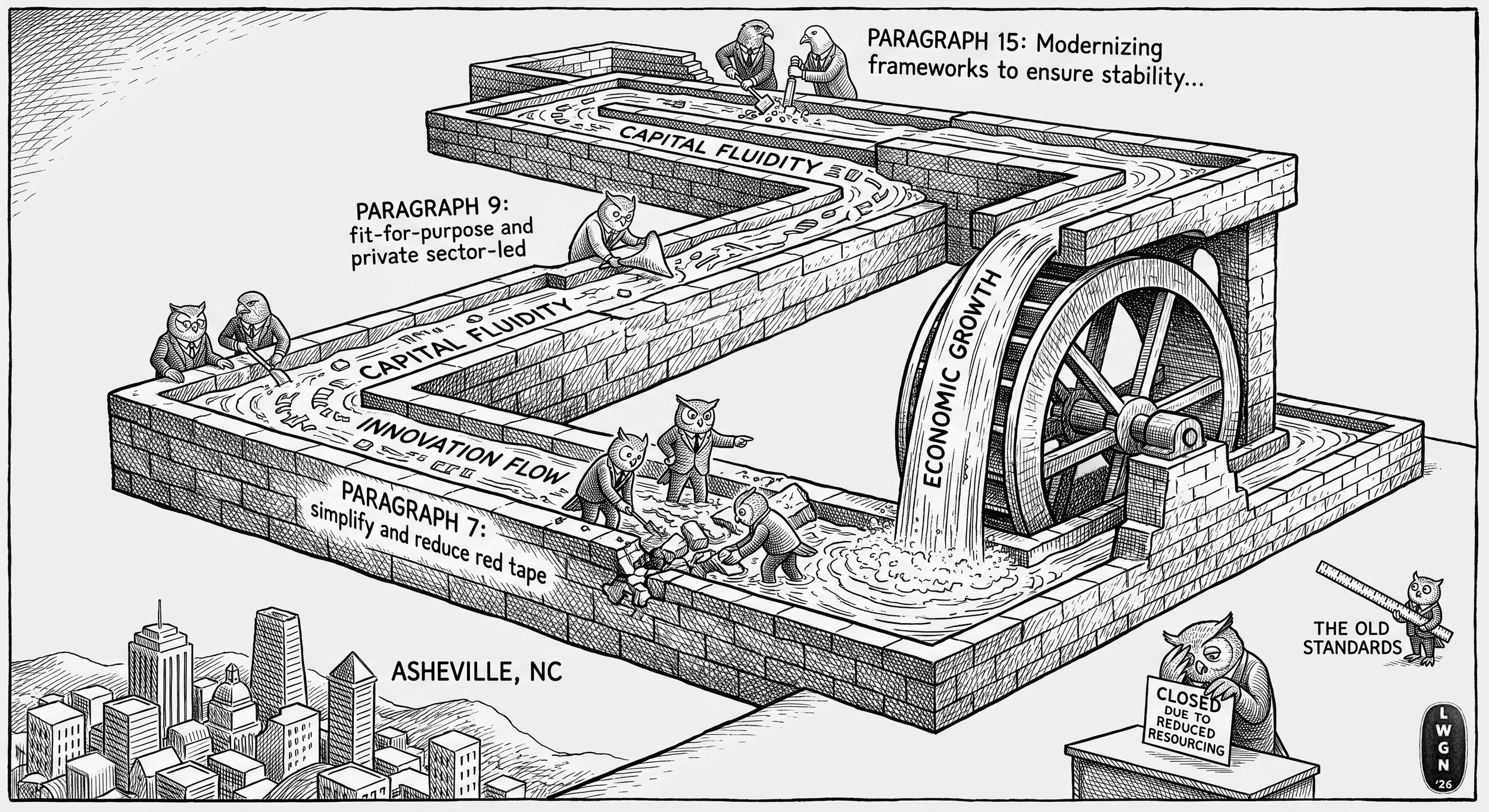
The King's Speech on Tuesday included two bills aimed squarely at regulatory burden: the Regulating for Growth Bill and the Competition Reform Bill. The first will impose a statutory mandate on named regulators to prioritise growth and pledges to cut administrative costs for business by 25%. The second will speed up aspects of the CMA’s work. Both are framed not as deregulation but as "modernisation".
They form part of a wider movement. In the United States, an executive order requires federal agencies to repeal ten rules for every new one they make; by the end of 2025, the White House reported agencies had finalised 646 deregulatory actions against only 5 regulatory actions — a ratio of 129-to-1, with DOGE now training AI tools to identify up to 100,000 federal regulations as candidates for the bonfire. In Brussels, ten "Omnibus" simplification packages are projected to cut €11.9 billion in annual administrative costs, with the headline package fundamentally reshaping the EU's corporate sustainability framework.
So is this just another swing of the pendulum?
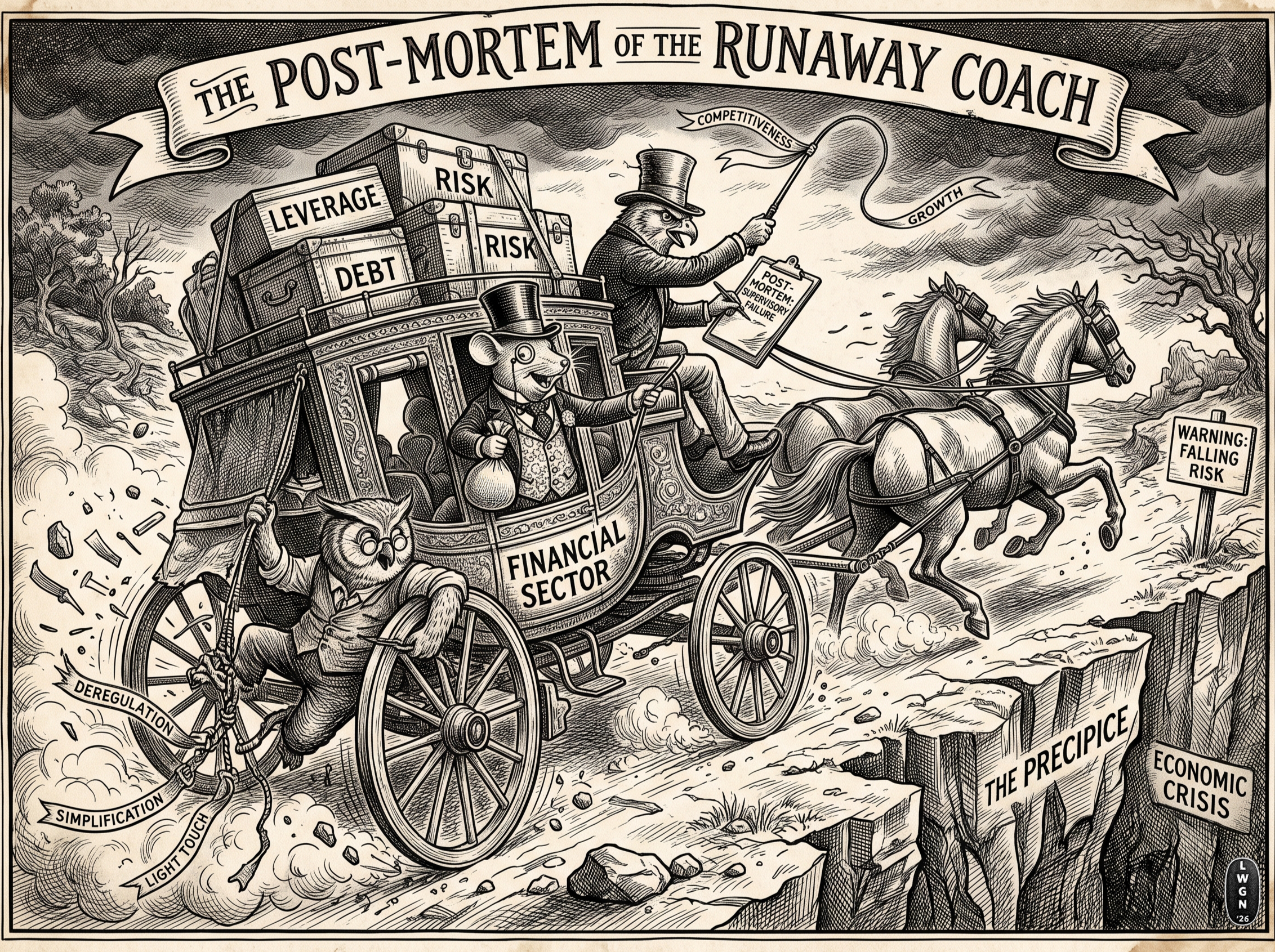
Not quite. We have seen waves of deregulation before — Reagan in the 1980s, Greenspan's light touch in the 1990s, the pre-crisis international convergence around market-friendly supervision. All of them reduced regulatory intensity. But they still largely operated within a framework in which competing objectives were explicitly recognised: stability, consumer protection, growth, competition. The balance could be struck badly, and often was, but the existence of competing claims was acknowledged. Stability mattered. Consumer protection mattered. Growth mattered. The job was to balance them.
What is different now is the disappearance of the acceptance that there needs to be a balance at all.
The Financial Services and Markets Act 2023 wrote competitiveness and growth into UK regulators' statutory mandates as a "secondary objective". The new Bill goes further for non-financial regulators, such as Natural England, the Environment Agency, and the Health and Safety Executive, allowing ministers to define what growth means in any given context and to issue binding strategic guidance. In the US, the courts and the executive, between them, have set about dismantling much of the administrative state itself. In Brussels, "simplification" extends beyond paperwork to reopening the substance of the post-crisis settlement. The rhetoric varies: Britain talks about the "boot on the neck" of business; America about constitutional governance; Brussels about competitiveness, but the underlying premise is shared. Regulation — not weak demand, productivity, or structural change — is held to be the binding constraint on growth.
This is the move that matters, and it is not really about “more” or “less” regulation. It is about whether the trade-offs involved are being made explicit. Lower capital requirements may create lending capacity, but they also reduce the cushion against losses. Lighter-touch supervision may encourage market entry, but it also gives problems more time to develop before anyone with authority intervenes. Streamlined approvals may get products to market faster, but they also weaken the filter that catches bad ones. These are not slogans. They are the elementary mechanics of regulation, and they do not vanish because politicians find them inconvenient.
The old post-crisis settlement, for all its frustrations, at least acknowledged the impossibility of having everything at once. Stability, consumer protection, competition and growth all mattered, and sometimes they pulled in different directions. The current movement too often implies that the conflict has disappeared: that regulation can be cut, growth unlocked, and resilience preserved without anyone having to say what extra risk is being accepted.
Unowned trade-offs, however, do not disappear. They are absorbed later, by whoever is left holding them when the consequences arrive.
Which sets up the accountability trap. Regulators were criticised before the 2008 crisis for being too restrictive, then criticised after it for failing to prevent what followed. They are now being instructed to prioritise growth. If, in due course, buffers prove too thin, supervision too light, or international coordination too fragmented, they will almost certainly be criticised for failing to prevent the consequences.
It is, of course, a legitimate political choice to accept more risk in exchange for more growth. Democracies are entitled to make that bargain. What is much harder to defend is pretending it has not been made, so that when stress arrives, the people instructed to lighten the touch carry the blame for what follows.
The cycle of crisis–regulation–complacency–deregulation has played out before and will play out again. We cannot abolish it. But we should, at least, be honest about where we are in the cycle and the choices we are making.
Fence and Sensibility: Deregulation and the Ring-Fence
UK’s deregulation debate is a dangerous game of Jenga in which no one knows which pieces are load-bearing.
This article first appeared in Financial World in their January 2026 Edition. It was made free to read in March.
Why the UK’s deregulation debate is a dangerous game of Jenga when no one knows which pieces are load-bearing
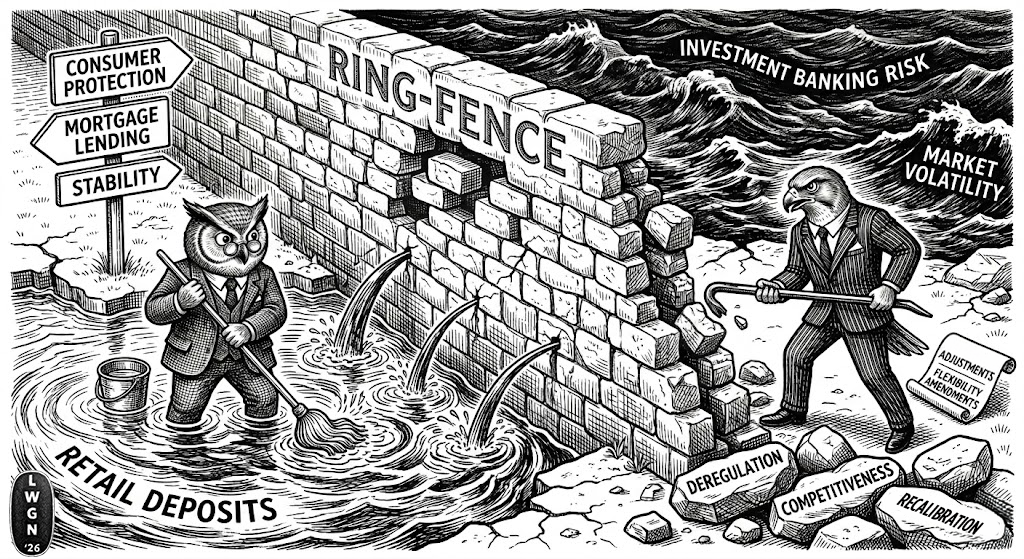
Since the global financial crisis, the UK has spent a decade and a half building an elaborate tower of bank safeguards: higher capital and liquidity standards, stress tests, resolution regimes and, uniquely, the legal ring-fencing of large retail banks. Now we have entered what one might call the Jenga phase of reform. Ministers and industry lobbyists want to start pulling pieces out of the structure, hoping that this ‘tower of resilience’ still stands.
In Jenga, players have some sense of which bricks are carrying weight and which are decorative. In banking regulation, no one can really say with confidence which rules are truly load-bearing. Banks argue for removing the constraints that make them feel most uncompetitive. Regulators, scarred by 2008–09, defend almost every brick as if it were the crucial one. Ring-fencing now sits in the middle of this regulatory Jenga debate. Much of this will be a non-discussion. Banks fixate on specific rules that, in their view, raise costs or slow down decisions compared to competitors just outside the perimeter. Supervisors talk almost exclusively at the level of the whole regime: the overall strength of capital and liquidity, the credibility of resolution, the integrity of the ring-fence. One side struggles with the nuts and bolts of day-to-day business; the other worries about the architecture of the entire safety net. When the industry asks for a few bricks to be removed, regulators hear an attack on the tower itself, while firms feel their pain points are dismissed as mere grumbling.
How the fence went up
The UK’s ring-fencing regime stems from the Independent Commission on Banking, chaired by Sir John Vickers, created after the crisis to tackle the “too big to fail” problem. Its central recommendation was that core retail banking – deposits, payments and lending to households and SMEs – should be legally separated from riskier trading and investment banking within large groups and insulated by their own capital and governance. That structure, implemented through the Financial Services (Banking Reform) Act 2013 and associated secondary legislation, has applied since 2019 to groups with more than £25 billion of core deposits.[1]
The aims were straightforward, even if the engineering was not: protect everyday banking services from shocks elsewhere in the group and make large banks easier to resolve without taxpayer bailouts, alongside the post-crisis resolution regime and “bail-inable” debt.[2] Bank of England analysis suggests that groups containing a ring-fenced bank benefit from cheaper funding and that UK households have enjoyed slightly lower mortgage rates as a result – a reminder that stability tools can support, not just restrain, the real economy.[3]
Smarter fences or open gates?
Into this uneasy dialogue stepped the Independent Review on Ring-fencing and Proprietary Trading, led by Sir Keith Skeoch. They concluded that ring-fencing had contributed to a more resilient retail banking system. However, the regime had become complex, rigid and, in places, misaligned with the evolving resolution framework. It recommended reforms to update thresholds, simplify rules and explore how, over time, ring-fencing might be better integrated with – or partially substituted by – robust resolution arrangements.[4] HM Treasury’s subsequent “smarter ring-fencing regime” essentially took forward those recommendations: a raised core deposit threshold from £25 billion to £35 billion, new exemptions and the loosening of some constraints on overseas operations and intra-group services, while insisting that the core purpose of the regime remains intact.[5]
Alongside this technocratic work, a sharper political turn has come. Chancellor Rachel Reeves has described aspects of the UK’s regulatory environment as a “boot on the neck of business”, signalling an ambition to reduce what she sees as unnecessary burdens on banks as part of a wider growth strategy.[6] Major bank chief executives have gone further, urging that ring-fencing be abolished altogether because it is outdated, constrains their ability to allocate capital and liquidity efficiently, and leaves them at a disadvantage compared with international rivals who do not face similar structural splits.[7]
Boots on necks, brakes on risk
Industry advocates also note that neither the United States nor the euro area adopted an equivalent structural separation regime, relying instead on activity restrictions, enhanced supervision and resolution planning.[8] Both contemplated similar reforms and backed away. In that light, some see the UK as over-engineered – an outlier whose well-intended architecture may now be blunting its competitiveness. But given the relative size of the UK's financial sector and its economic openness, being an outlier may be appropriate.
On the other side of the ledger, few of the regime’s architects and guardians believe the time has come for radical dismantling. The Skeoch Review itself posed an existential question – whether ring-fencing was still necessary given other post-crisis tools – but ultimately concluded that it remained a valuable part of the UK’s financial stability toolkit.[9] The Bank of England has stressed that ring-fencing improves resolvability and underpins lower optimal capital levels than would otherwise be needed. Andrew Bailey has called it “not sensible” to tear up the regime and has pushed back on the “boot on the neck” characterisation, arguing that financial stability and growth are not opposing goals.[10]Some industry voices, including the chief executive of at least one major UK group and arguably the most impacted by ring-fencing, have even broken ranks to warn against scrapping ring-fencing outright.[11] That could lead some to highlight an inconvenient truth about the ring-fence: it is a very effective barrier for some banks below the threshold from growing. Indeed, for many of the architects of the regime, this is a feature, not a bug.
The global context hardly encourages complacency. The failures of several US regional banks and the forced rescue of Credit Suisse in 2023 underlined how quickly confidence can evaporate when large, complex institutions wobble. Dismantling structural safeguards just as memories of the last crisis fade is a bold bet that all the other post-crisis tools will work flawlessly under stress.
Mind the gaps
The more interesting question is not whether to keep or scrap ring-fencing, but how to adapt it in a financial system where risks increasingly sit outside large banks. Since the crisis, a growing share of credit and market intermediation has migrated into non-bank finance – private credit funds, money market funds, hedge funds and fintech platforms. Many of these entities sit under lighter regulatory and resolution regimes than banks, yet they can transmit stress back into the core system through funding markets and derivative exposures. Tweaking structural rules for a handful of UK banking groups will not change that reality.
That strengthens the case for a more explicit, system-wide framing of the deregulation debate. If the aim is to support productive investment and lending, policymakers need to ask where incremental risk will ultimately fall if bank rules are relaxed, and whether supervision of non-banks and market-based finance is keeping pace. That suggests a different conversation between regulators and industry – one in which supervisors are clearer about which parts of the ring-fence they regard as genuinely load-bearing, and banks are more honest about which complaints are truly competitiveness-critical rather than simply inconvenient.
One promising avenue, already floated in official papers, is a more conditional approach to deregulation. In principle, if a bank can demonstrate – through credible, independently assessed resolution plans and loss-absorbing capacity – that it can fail safely without public support, then there is a case for gradually reducing the intensity of some structural constraints. But doing so requires agreed metrics, transparent assessments and a willingness to re-tighten rules if early warning indicators flash amber. A one-way ratchet towards ever-lighter regulation would be Jenga without a hard hat.
Mending, not ending, the fence
The real test for the next phase is whether policy-makers can distinguish between two options: one, mending the fence so it does its job better and two, opening so many gates that the structure stops offering meaningful protection altogether. If reforms amount to targeted changes linked to demonstrable improvements in resolvability and better evidence on real-economy outcomes, they will be overdue. If they leave the field wide open just as the lessons of the last crisis are fading from memory, we may yet discover that what some saw as a boot on the neck of business was also a hand on the tiller of stability.
[1]Bank of England Quarterly Bulletin article, “Ring‑fencing: what is it and how will it affect banks and their customers?”, 2016 Q4:
[2] ibid
[3]Bank of England, Letter from Andrew Bailey to Dame Meg Hillier MP on ring‑fencing, 28 May 2025:
[4] Independent Panel on Ring‑fencing and Proprietary Trading (Skeoch Review), Final Report, March 2022 (landing page with PDF link):
[5] HM Treasury, “Ring‑fencing reforms” (policy paper, 9 December 2022):
https://www.gov.uk/government/publications/ring-fencing-reforms
[6] Mansion House speech video (for a public, non‑paywalled reference):
https://www.youtube.com/watch?v=pi9WQg5q1Ro
[7] Reuters, “Top British bank chiefs urge finance minister to scrap ring‑fencing in letter”, April 2025:
https://www.reuters.com/business/finance/top-british-bank-chiefs-urge-chancellor-scrap-ring-fencing-letter-sky-news-2025-04-26/
[8] Slaughter and May, “UK bank ring‑fencing: worthwhile reforms?”, November 2024:
https://www.slaughterandmay.com/insights/new-insights/uk-bank-ring-fencing-worthwhile-reforms/
[9] Independent Panel on Ring‑fencing and Proprietary Trading (Skeoch Review), Final Report, March 2022 (landing page with PDF link):
[10] Reuters piece covering Bailey’s July 2025 Treasury Committee exchange with Reeves’ comments:
[11] Example of press reporting citing Barclays Group CEO C.S. Venkatakrishnan on retaining ring‑fencing in 2025 is typically folded into broader ring‑fencing reform and Mansion House coverage (often paywalled); one accessible route is via aggregated coverage and commentary, for example:
https://www.regulationtomorrow.com/eu/mansion-house/ (Shearman commentary summarising Mansion House and ring‑fencing debate)
Big Tech: From here to the entity
Same activity, same risk, same regulation" sounds like plain fairness when regulating Big Tech in finance. Lyndon Nelson shows why it is far more complex — why context decides everything, why activity-based rules alone won't hold once tech firms turn systemic, and why an entity-based regime, hard as it is to build, is needed before a failure exposes the gap.
Lyndon Nelson looks at the challenges of finding an appropriate framework for regulating Big Tech’s growing importance in the financial system, as some banks call for tech firms that are active in financial services to be regulated by function. This article first appeared in Financial World in February 2023.
It is possible that, even before homo sapiens evolved as a species distinct from other early humans, there was the specialisation of labour and, as technology like the use of tools advanced, some specialisms became redundant and new ones were created.
In that light, not much has changed over the past 300,000 years. Technological advancement still comes with both opportunity and the potential for uncomfortable consequences. However, in financial services, the issues that innovation trigger are not just questions for the industry itself – about which business models will survive and how the sector will change – but also for wider society and for the regulators that often represent the interests of society.
The very real risk for regulators, as financial services business models break up, is that they end up overseeing an increasingly irrelevant backwater, while the meaningful business flow is elsewhere. That’s because regulation is based largely on a vertically integrated model – that is it assumes that regulated financial services firms control all aspects of a product in-house – much as AT&T used to own forests that provided telegraph poles. If you manage the firm, you have a grip on the function. However, the increasing adoption of technology by existing financial services players, and the increasing penetration of financial services by technology companies, mean that vertical integration no longer holds.
Same activity, same risk, same regulation?
In any debate on the structure of regulation, there will often be a concern to maintain a level playing field. There is even a rallying cry of ‘same activity, same risk, same regulation’. As intuitively attractive as this might appear, in reality it is more complex. Getting regulation right critically depends on a correct understanding of the context of the activity and the risk it represents.
After all, why regulate financial services at all? There are many reasons why a society decides to regulate, but two tend to dominate for financial services. The first is to reduce risk at the macro-level, because the financial system provides key functions to the real economy such as managing risks and uncertainty, facilitating investment and allocating resources. The overall aim there is financial stability. The second reason to regulate is at the micro-level and it concerns consumers’ interaction with the financial system and whether, given the many asymmetries involved, it is fair. That comes under the umbrella of consumer protection.
Although it is the functions carried out by financial services that drive the case for regulation, generally regulators have struggled to define functions clearly enough to provide a basis for a statutory system – ie one that puts limits on those functions into law. Instead, they have focussed on activities such as the provision of a financial service like payments, or deposit taking.
However, when looking at activities, context is key. Making a deposit as an advance payment on that kitchen you have always wanted is one thing, but a deposit that might be used in payments and as a source of funding for lending and investment is quite another. In many cases, decisions on how and what to regulate will quickly become decisions about the strength of the balance sheet of the entity providing the services. When we make a deposit with a bank, we become a creditor of that bank. Whether we can get that deposit back will partly depend on whether the bank is liquid and solvent.
So, even though a regulator may care most about the activities carried out, in many cases the entity that carries them out is also important. This leads to two forms of regulation:
activity-based – which focuses directly on how entities carry out an activity – and
entity-based, which focuses on the entities that perform activities and seeks to strengthen their resilience.
In activity-based oversight, regulation should not normally vary with the entity that carries out the activity – although again the context is key here. To be successful, regulators need to be capable of influencing the probability, and impact, of the failure of a particular activity, independently of the provider’s other activities and, in extremis, of the failure of the entity itself. Examples of such regulation are conduct of business rules for the sale of a mortgage and operational standards for payments provision.
Entity-based regulation is indirect regulation of the activity and will typically look at the probability, and impact, of the entity failing. By its nature, entity-based regulation is best suited to regulating combinations of activities. Examples of such regulation are minimum capital requirements and concentration limits.
To the entity and beyond
Within themselves, both entity and activity-based regulation can be level playing fields. However, if the context is one where either or both trigger a macro or financial stability risk, then there will be differentiation between those generating a macro risk and those that do not. For example, there are higher operational resilience standards for entities that have a significant market share of payments activity, and additional capital is required for systemically important banks. This, of course, breaks the purist form of ‘same activity, same risk, same regulation’ unless ‘same risk’ covers both a micro and macro context.
Given that both activity and entity-based regulation have strengths and weaknesses depending on the circumstances, in many cases the regulatory approach is a hybrid. Typically, that means prudential and financial stability regulators focussing on the entity and securities and conduct regulators focussing on activities.
Techs and balance
Financial services firms have often been very early adopters of new technology. The most recent wave of technology is different in that technology firms are entering the financial services market directly. The move started in areas such as infrastructure, fulfilment, customer analytics and customer interfaces, which were areas of strength for tech firms, and the work was done in partnership with incumbent financial services firms. But, increasingly, the technology companies are moving into direct competition. This has meant positioning in product design – most commonly in payments. An activity-based approach could allow regulators to impose the same regulatory measures on these technology companies as on others performing the same activities – this would include differentiated (ie higher) requirements where technology companies have a systemic significance. However, this is unlikely to be sufficient. Just as in financial services, the business models of technology companies are a complex web and these interactions and interdependencies may mean that it is difficult to isolate the activity. Also, in some cases, we have already passed the point where there would be systemic implications if one of these technology companies were to fail. This suggests a focus beyond the activity to include entity-based regulation, which may need to be differentiated if macro-risks are also high.
Although it’s an obvious point, it bears re-stating that an entity-based system relies on an easily definable entity that engages in what the regulator is interested in. What seems inevitable is that a functioning entity-based approach for tech companies will take some time to set up, even at the domestic level. An internationally agreed entity-based system of regulation is likely to be someway off, if only because tech firms do so much business cross-border. Fundamentally, the legislation required is not there in many cases. Further, technology companies understandably have not organised themselves with financial (or, indeed, other) regulation in mind and the regulatory community has yet to work out how they will organise the regulation of technology companies.
Reality tech
It is likely that regulation of technology companies will continue to evolve, with regulators trying to make the most use of their existing powers where possible, this probably means some form of enhanced disclosure initially, but inevitably a specific entity-based regime will need to be created. This will need clear international standards and some re-structuring of technology companies. These are both steep cliffs to climb, but they need to be tackled before a failure highlights the inadequacy of the system we have now.
What happens when CoCos pop?
Additional tier 1 bonds are popular with banks that need to raise capital but are risky for investors and may be controversial when a crisis occurs. Lyndon Nelson looks at whether they can still have a future
This article first appeared in Financial World, May 2023 Edition
Additional tier 1 bonds are popular with banks that need to raise capital but are risky for investors and may be controversial when a crisis occurs. Lyndon Nelson looks at whether they can still have a future
Contingent convertible bonds (CoCos) were seen as an important part of the response to the 2008 financial crisis. Policy makers wished to avoid the taxpayer-
funded bailouts of the crisis clean-up and to move to a world of bail-in, where the burden would shift to capital markets, which would be compensated for taking on this risk.
CoCos, as the name implies, convert into equity upon breaching a trigger – typically a specific core equity tier 1 ratio (CET 1). They are perpetual bonds, although markets had become used to them being redeemed at the first call option.
CoCos are designed to be loss-absorbing – either through the conversion to equity or by means of a principal write-down – and pay a coupon which, if the bank opts not to pay it, is non-cumulative. That is, it is lost forever and does not generate any further obligation.
Given these features, the Basel Committee on Banking Supervision allowed CoCos to count towards capital, which is why they became known as Additional Tier 1 (AT1). The Committee also set out that conversion should be triggered if a bank’s CET1 fell below 5.125%. There was also a discretionary trigger to be activated by regulators if, in their judgment, the bank had reached a point of non-viability. Finally, the amount of AT1 that could count towards capital was limited to a maximum of 1.5% of risk-weighted assets.
In the creditor hierarchy, AT1s rank junior to all other debt and are senior only to ordinary and preference shares. Because of this ranking, AT1s pay a higher coupon than traditional bonds and offer higher yields. When Credit Suisse refinanced its AT1 in 2022, it offered a coupon of 9.75%. To compare, the yield on 10-year treasuries in mid-June 2022 was 3.49%.
Why banks like AT1s
AT1s proved popular with banks that needed to raise capital, particularly European ones, which dominate the issuers. In the US, an instrument called preferred shares plays the same role as AT1s, with the same place in the capital structure. Outstanding issuance grew to around $275bn.
There were good reasons for banks to offer AT1s. They improve overall capitalisation, decreasing the fragility of a bank; narrow credit spreads – that is the difference
between what the bank pays to borrow and the risk-free rate; and lower the overall cost of funding. They do this without diluting equity, so long as there is no conversion. And, because coupon payments are tax deductible in many jurisdictions, while dividends are not, AT1s are cheaper to issue than new shares.
For regulators, AT1s provide additional loss absorbency in a capital-efficient way and do so at a time when a bank is under stress – the moment when other forms of capital raising would be difficult or even prohibitively expensive. In addition, a responsibly operated bank should wish to avoid triggering conversion and would manage itself accordingly.
Why investors get skittish
Investors in AT1s get comparatively higher coupons in exchange for higher risk. These risks vary in their opacity. One is the subordination to all other debt. Then there is the risk of write-down or conversion. Investors also have to consider changes in credit spread, which typically have a greater impact on subordinated bonds. Not least, there is also the uncertainty of potential regulatory intervention.
It is probably the intersection between policy makers wanting to maximise their room for manoeuvre if a bank is in a crisis, and the uncertainties that inevitably generates for investors, that has led the AT1 market to be somewhat febrile. The recent outcry over the write-down of the AT1s at Credit Suisse is making headlines now but there have been challenges before.
In 2016, for example, the then Chief Financial Officer at Deutsche Bank, Marcus Schenck, told analysts that he believed the bank would be able to pay the coupon on its AT1s. By raising the possibility of missed coupon payments, Schenck, predictably, spooked the market.
In 2017, the European Central Bank put Banco Popular Español into resolution, triggering the conversion of its AT1s, which led to unsuccessful litigation by bondholders.
In the UK, regulatory stress tests were generating outcomes that, if they ever came to pass in practice, would trigger AT1 conversion for some banks – serving as a reminder of the risks of AT1. More recently, during the height of the Covid pandemic, it was not unusual to see articles questioning whether the AT1 could survive.
The Credit Suisse controversy
This brings us to the present and the AT1 market is once again in the spotlight. On the face of it, the write-down of around $17bn in AT1s at Credit Suisse is exactly what should have happened. A major bank was effectively insolvent
and the write-down reduced the burden on the taxpayer by placing it on investors who knew they had bought risky instruments designed to be wiped out if the bank failed.
But the controversy is that shareholders were not completely wiped out. The normal credit hierarchy in an insolvency sees equity holders take the first loss. In this case, however, AT1 investors were treated more harshly than shareholders. The AT1 investors are now reaching for their lawyers.
Do they have a case? Credit Suisse’s AT1 documentation did allow for this outcome in certain circumstances. The Swiss regulator, Finma, said: “The AT1 instruments issued by Credit Suisse contractually provide that they will be completely written down in a ‘viability event’, in particular if extraordinary government support is granted.” Other jurisdictions, such
as the EU and UK, have been quick to reassure investors that they will abide by the creditor hierarchy, hoping that this isolates any investor concerns to just banks in the Swiss market.
Was Finma right?
Should the Swiss authorities have taken this decision? I don’t know, but I can understand it. A disorderly failure of such a large institution would have a severe impact on the financial system. There was a need for decisive action. Any action also needed to cause the least amount of secondary impact to stem any contagion risk. Given that the Swiss authorities had the option provided in the contractual terms to change the creditor hierarchy, they were duty-bound to consider it and evidently thought this was preferable. Many will argue that this was the wrong call, as they believe the contagion to the wider AT1 market is significant.
But, for the Swiss, I suspect, this came down to just a one-period game. Although UBS has a lot of AT1 in issuance, the merger with Credit Suisse gives it an asset base of around $1.5tn, according to S&P.To put that into context, the annual GDP of Switzerland is around $800bn. UBS is now not just the only globally systemically important bank in Switzerland, it is also clearly ‘too big to fail’. That means that many of the underlying AT1 risks are now, fundamentally, Swiss sovereign – and Swiss regulatory – risk. So, any future issuance of UBS AT1s will face a different risk calculation by investors, but it is uncertain what they might do.
The markets will be watching
Where this takes AT1 issuance will depend on the results of the legal cases and how the market prices in the experience of Credit Suisse. A situation in which AT1s become more expensive to issue than equity, which would equate to a full-out buyers’ strike, could prompt a debate about some of the design weaknesses of AT1s.For example, regulators might consider whether triggers should be set higher and thereby reduce the chances that a discretionary trigger is exercised. They could also look at whether triggers based on CET1 are sufficiently transparent to investors, given that CET1 levels are, typically, only disclosed quarterly.
Policy makers should consider whether they need to do more to explain their decision-making in times of crisis. This explanation is not just for the sake of the AT1 market but for the much larger market of Total Loss Absorbing Capital (TLAC). In Europe, the term used is the minimum requirement for own funds and eligible liabilities (MREL).
This is another set of liabilities designed to take losses in a crisis and banks have been issuing between $350bn to
$400bn annually since 2019. Because TLAC relies heavily on the decisions of policy makers in a crisis, today’s troubles for AT1 may be a source of similar contagion for TLAC. I am sure TLAC investors will be watching closely.